-
Faculty: Visual Arts, Arthur C. Clarke Center for Human Imagination
Building tools for an experimental documentary exploring intimacy, embodiment, and alignment in the evolving relationship between a human parent and robot dog.

"Becoming BFFs" explores intimacy, embodiment, and AI alignment in the evolving relationship between a human parent and their robot dog. Using LIDAR imaging, 360° video, and snapshots of internal AI model states, I have piloted a hybrid cinematic language that blends human and machine perception. The project extends traditions of cinéma vérité in an algorithmic register, asking what it means to see our selves through the perceptual and cognitive systems of machines. It turns those introspective technologies to describe an emerging human-robot relationship.
This fellowship builds towards a larger project, BFF, with artist-researcher Jesse Fleming.
Learn more at the projct website: https://roberttwomey.com/bff
Fellowship Cohort: Fall 2024
Why did you choose this project?
This project brings together several threads in my practice—experimental video, computational imaging, and human-robot interaction—while opening a new space to interrogate intimacy and alignment in the age of embodied AI. The arrival of accessible quadruped robots and local language models offers an opportunity to stage and inhabit these evolving bonds, grounding theoretical concerns about AI alignment in lived, intimate encounters. This project extends my prior work on robotic cameras and algorithmic perception into a deeply personal, autoethnographic register, asking not just what multi-modal machine perception can produce as documentation, but how training and conversing with a robot dog transforms my own sense of relation and care.
This fellowship work is part of a larger project, BFF, with artist-researcher Jesse Fleming. Progress here feeds into that larger new media artwork / experimental documentary.
How was this fellowship meaningful or impactful to you?
The SICCA Fellowship was meaningful because it placed my arts-and-engineering practice within a cinematic arts context. Grounding this inquiry in cinematic language, I am able to explore how machines see, feel, and move through the world alongside us, reflecting on the affective bonds we form with them. This project is developed as an experimental documentary and new media artwork — and so can be shown either way as film or performance.
Practically, it afforded me the chance to fund intensive development work with research staff and collaborators. This fellowship is uniquely broad in its definition (and support) of cinematic arts.
Have you showcased this work in any other ways or places? Do you have any future plans related to this work?
This is the first public presentation of this project (!). The project is being developed both as an experimental documentary and new media artwork — and so can be shown either way as film or performance. I will be doing a performance-lecture at the Claremont Mckenna Ath Lecture Series (Nov 6), with other performance/screenings under review for 2026.
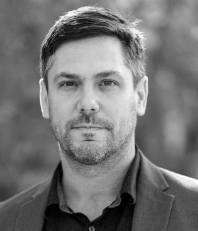
Robert Twomey is an artist and engineer exploring the ways we share space with machines, particularly how emerging technologies transform sites of intimate life. His work has appeared at SIGGRAPH (Best Paper Award), CVPR, NeurIPS, ISEA, and the Museum of Contemporary Art San Diego, with support from the NSF, Microsoft, Amazon, HP, and NVIDIA. He has been artist-in-residence at Nokia Bell Labs’ Experiments in Art and Technology (E.A.T.), Carnegie Mellon’s STUDIO for Creative Inquiry, and the NYC Media Lab x Bertelsmann. Twomey is a professor of Visual Arts and a researcher with the Arthur C. Clarke Center for Human Imagination at UC San Diego, where he directs the Machine Cohabitation Lab.